

 Key Takeaways
- Fans cost cents, air conditioners cost tens of cents
The ACT Government puts fans at 1 to 3 cents an hour to run and split systems at 15 to 50 cents an hour, depending on size, efficiency and temperature setting.
- Work out your own numbers in kWh
Multiply the power the appliance draws (in kW) by the hours it runs to get kWh, then by your tariff. At about 40 cents per kWh, a 30 watt DC fan costs about 1.2 cents an hour.
- Use both together
A fan's breeze feels about 3 degrees cooler. Each degree you raise the air conditioner saves 5 to 10% of its energy, so a fan plus a higher setting usually costs the least for the same comfort.
- Canberra nights help
Canberra usually cools down after dark. Fans and open windows at night, then closing up in the morning, can carry many summer days with little or no air conditioning.
A ceiling fan costs far less to run than an air conditioner. The ACT Government’s cooling guide puts fans at 1 to 3 cents an hour and split systems at 15 to 50 cents an hour, depending on their size, efficiency and temperature setting. On those figures, an hour of air conditioning can cost as much as a whole night or more of running a fan.
The catch is that a fan does not cool the room. It cools you, by moving air over your skin. On many Canberra summer days that is enough, and on the hottest afternoons the best result usually comes from using both: the fan running and the air conditioner set a few degrees higher. Below we work through the numbers in kWh and cents an hour, using official figures and a cited ACT tariff, so you can do the same sum for your own home.
What electricity rate should you use?
Running cost is simple arithmetic: the power an appliance draws in kilowatts (kW), times the hours it runs, gives kilowatt-hours (kWh). Multiply kWh by your usage rate and you have the cost.
Your usage rate is on your bill, and it depends on your retailer and plan. For the examples in this guide we use about 40 cents per kWh, including GST. That comes from the ACT regulator’s 2026-27 standing offer estimates: the ICRC’s report puts an average household (6,500 kWh a year) at $2,400 and a large one (7,500 kWh) at $2,769, before GST. The extra 1,000 kWh adds $369, or about 37 cents per kWh, which is about 40 cents with GST.
The ICRC also says fewer than 20% of ACT customers are on the standing offer, and most market offers are priced below it. If your rate is lower, your costs will be lower than the examples. If you have rooftop solar and run the fan or air conditioner in the middle of the day, much of it may come from your own panels.
How much does a ceiling fan cost to run?
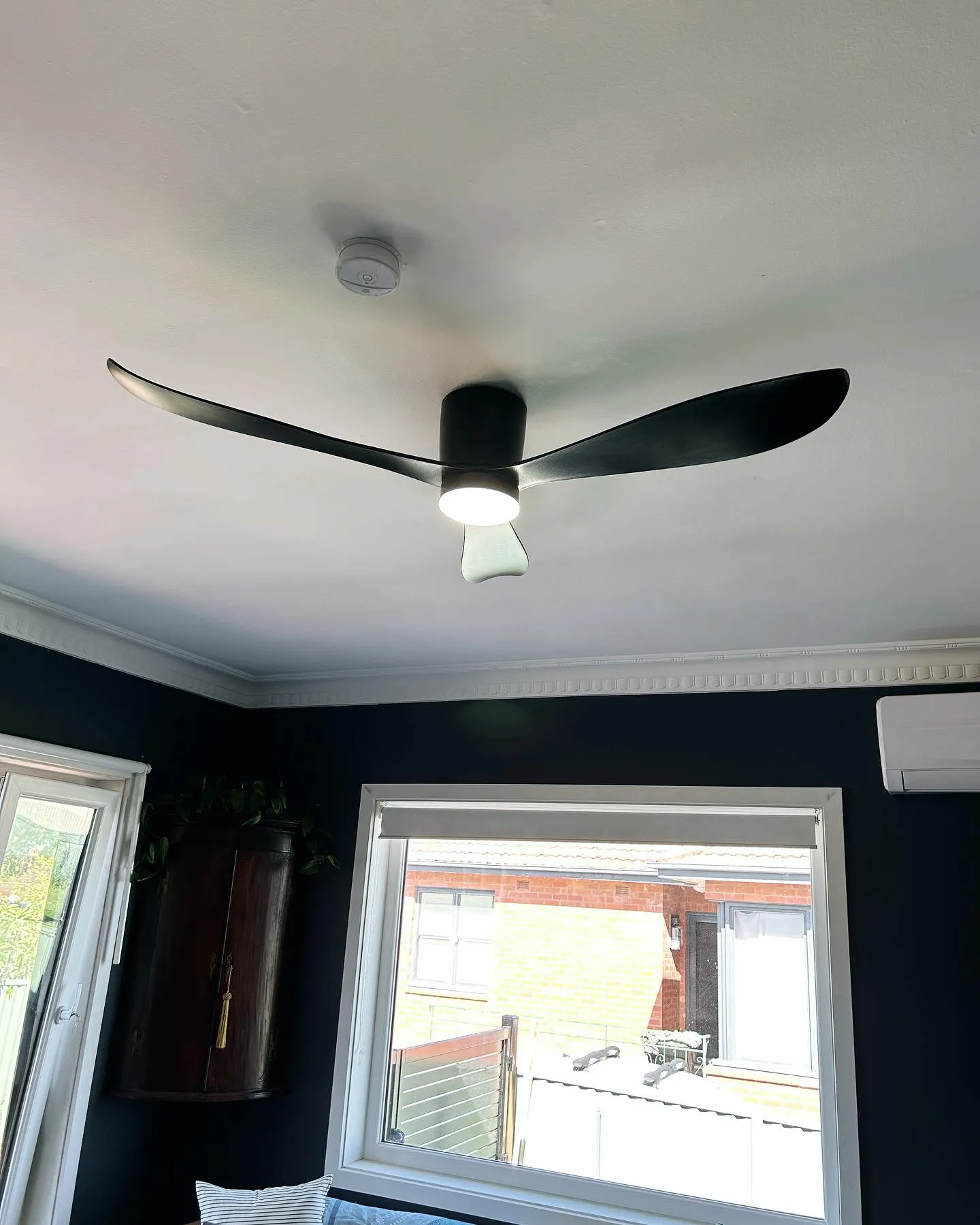
The Australian Government’s YourHome guide puts a DC motor ceiling fan at about 30 watts, which is about half the energy of a traditional fan. At 40 cents per kWh:
- DC fan, 30 watts: 0.03 kWh an hour, about 1.2 cents an hour. All night for 8 hours is 0.24 kWh, under 10 cents.
- Traditional AC fan, about 60 watts: 0.06 kWh an hour, about 2.4 cents an hour. 8 hours is 0.48 kWh, about 19 cents.
Those sit inside the ACT Government’s 1 to 3 cents an hour, and close to energy.gov.au’s figure of around 2 cents an hour. Our guide to DC vs AC ceiling fans covers which suits each room, and our ceiling fan installation page shows the fan work we do.
How much does it cost to run an air conditioner in Canberra?
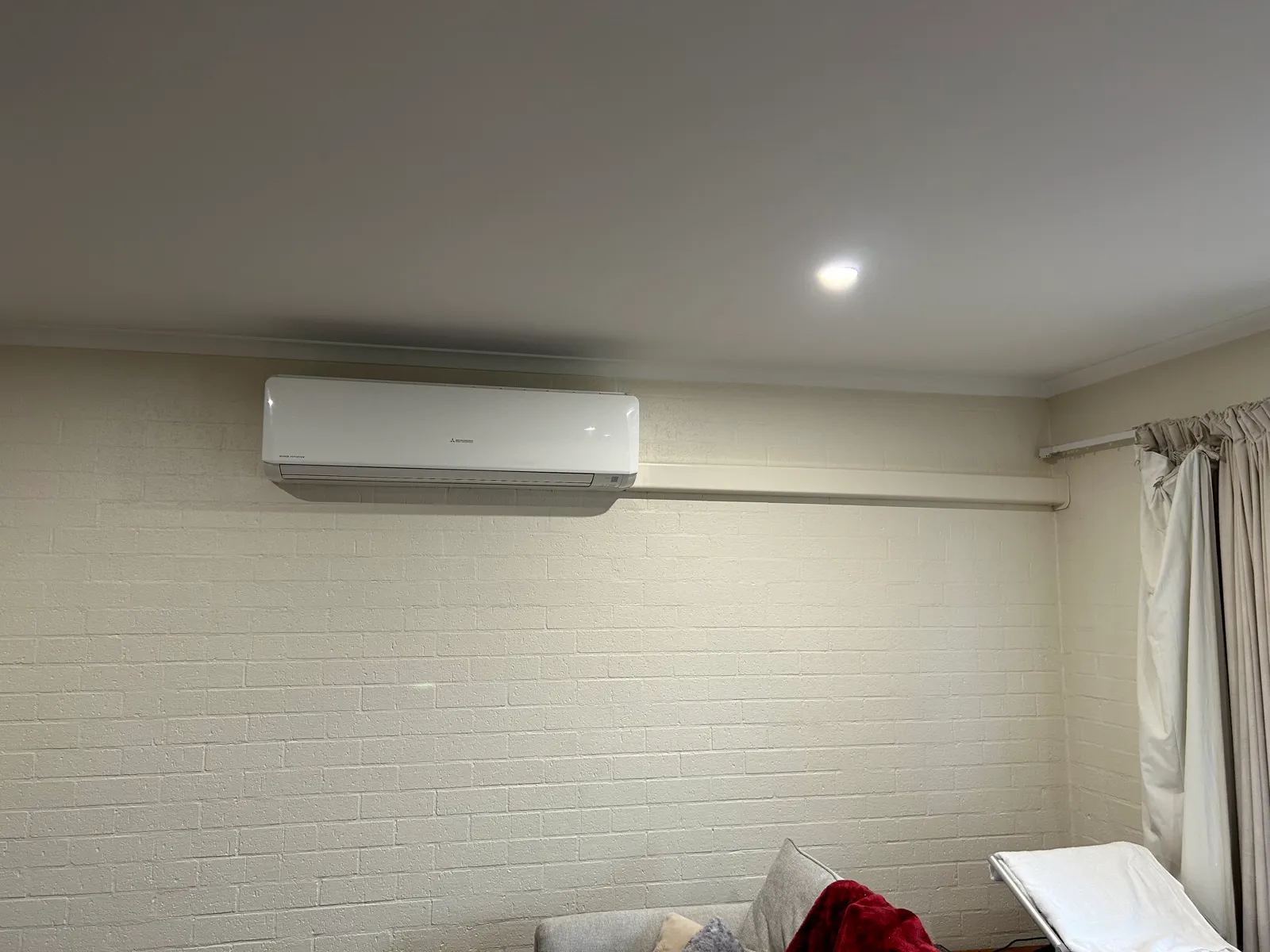
The ACT Government’s range for split systems is 15 to 50 cents an hour. At 40 cents per kWh, that means a split drawing somewhere around 0.4 to 1.25 kW of electricity while it runs.
To work out your own unit, look for the power input in kW on the Energy Rating label or specification sheet, not the cooling capacity. A split sold as “5 kW” usually means 5 kW of cooling output. Because a reverse cycle air conditioner moves heat rather than making it, the power it draws is a fraction of that. The Energy Rating calculator lets you compare models and estimate their running costs.
Actual use also changes through the day. An inverter split draws the most when it first pulls the room down to temperature, then much less while it holds it there.
Worked example: a hot Canberra evening
Say it is 33 degrees and you cool the living room from 4pm to 10pm, six hours, with a split averaging 1 kW of electrical input. At 40 cents per kWh:
| Option | Energy used | Cost for the evening |
|---|---|---|
| Split system only, 1 kW for 6 hours | 6 kWh | about $2.40 |
| DC ceiling fan only, 30 W for 6 hours | 0.18 kWh | about 7 cents |
| Split set 2 degrees higher, plus DC fan | 4.8 to 5.4 kWh plus 0.18 kWh | about $2.00 to $2.23 |
The last row uses energy.gov.au’s figure that each degree of extra cooling adds 5 to 10% to the energy used. Raising the setting by 2 degrees saves 10 to 20%, or 0.6 to 1.2 kWh, which is 24 to 48 cents, and the fan costs about 7 cents of that back. Your numbers will differ with the unit, the room and the weather, but the pattern holds.
Does running a fan with the air conditioner save money?
Yes, as long as you turn the air conditioner up. A fan’s breeze gives about the same comfort as lowering the temperature by around 3 degrees, according to energy.gov.au. YourHome’s advice is to use that to run the air conditioner at a higher setting, ideally 25 to 27 degrees in summer, which cuts the energy used for cooling. The ACT Government suggests 23 degrees or above with the doors closed.
A fan left running in an empty room saves nothing, because it cools people, not air. Turn fans off when you leave, and use a timer or the remote on DC fans.
When does a fan make sense, and when do you need air conditioning?
A fan is usually enough on warm days in the high 20s, in bedrooms overnight, and when the house can be cooled down by outside air. Canberra nights usually cool off well after a hot day. The ACT Government’s tip is to open windows and run fans at night, then close everything up early in the morning to trap the cool air in, with blinds drawn on the sunny side.
Air conditioning earns its keep during heatwaves, when nights stay warm, in rooms that heat up under the roof or face west, and for anyone vulnerable to heat such as babies, older people and people with health conditions. A reverse cycle split also heats your home in winter, which in Canberra is where it saves the most against other heaters. Our split system installation guide explains the electrical side, and our heating and cooling page covers the split system work we do.
What about the electrical work?
Running costs only matter once the equipment is in and wired properly. A ceiling fan needs to be fixed to the ceiling framing and wired by a licensed electrician; see our fans and exhaust page. A split system needs its own circuit, room on the switchboard and an isolator at the outdoor unit; see our heating and cooling page.
Summer is when this work gets busy. Fans and exhaust work make up 14% of our summer quote requests, against 6% in winter, as covered in our Canberra electrical enquiries study. Getting fans and splits in before the first heatwave is the easiest way to start saving from day one.
Frequently asked questions
Is it cheaper to run a ceiling fan or an air conditioner?
A ceiling fan, by a long way. The ACT Government puts fans at 1 to 3 cents an hour and split systems at 15 to 50 cents an hour. A fan does not lower the room temperature, though. It makes you feel cooler by moving air, which is enough on many Canberra summer days.
How much does it cost to run a split system per hour in Canberra?
The ACT Government's guide is 15 to 50 cents an hour, depending on the unit's size, efficiency and temperature setting. For your own unit, multiply the power it draws in kW by your tariff in cents per kWh. A unit drawing 1 kW at 40 cents per kWh costs about 40 cents an hour.
What temperature should I set my air conditioner to in summer?
The Australian Government recommends 25 to 27 degrees in summer, and the ACT Government suggests 23 degrees or above with doors closed. Each degree cooler adds 5 to 10% to the energy used, so a fan and a setting of 25 or more saves the most.
How much power does a ceiling fan use?
YourHome puts a DC motor ceiling fan at about 30 watts, about half the energy of a traditional fan. At about 40 cents per kWh, a 30 watt fan running all night for 8 hours uses 0.24 kWh, which costs under 10 cents.
Does running a fan with the air conditioner save money?
Yes, if you raise the air conditioner's setting. A fan's breeze gives about the same comfort as lowering the temperature by around 3 degrees, so you can set the split higher and it uses less energy. The fan itself adds only a cent or so an hour.
What is the electricity rate in the ACT?
It depends on your retailer and plan. The ICRC's 2026-27 standing offer estimates work out to about 37 cents for each extra kWh before GST, or about 40 cents with GST. Most ACT households are on market offers, which the ICRC says are mostly cheaper, so check the usage rate on your own bill.
Conclusion
In a Canberra summer, a ceiling fan costs about a cent an hour and a split system costs tens of cents, so the lowest cost approach is to use fans first, open up at night, and run the air conditioner on hot afternoons at 25 degrees or higher with a fan going. If you are adding fans or a split system, the electrical work matters: the right circuit, a sound switchboard and a fan fixed properly to the ceiling. Fused Electrical Co is a family owned and run Canberra business, licensed and insured, with fixed-price quotes and a reply within 24 hours. Call 0434 913 935 or request your free quote online and get set up before the hot weather.
Published Date:
Link copied!
Talk to a licensed Canberra electrician.
Family owned, rated 5.0 from 163 Google reviews. Serving Canberra, the ACT and Queanbeyan.
Article Sources / Publishing Guidelines
Sources
- climatechoices.act.gov.au · cooling for your home
- energy.gov.au · heating and cooling
- energy.gov.au · summer
- yourhome.gov.au · heating and cooling
- icrc.act.gov.au · Report Retail electricity price recalibration 2026 27
- calculator.energyrating.gov.au
At Fused Electrical Co, we are committed to publishing content that is accurate, trustworthy, and useful for our readers. To maintain these standards, we follow a rigorous process:
- All content is crafted to be clear, helpful, and regularly updated.
- We adhere to strict practices, including:
Editorial Guidelines
Fact-Check Content
Vet Expert Sources
Content Creation Process - If you have any questions, concerns, or if you’ve found an error in our content, please contact us.