

 Key Takeaways
- DC fans use about half the power
The Australian Government's YourHome guide says ceiling fans with DC motors use about 30 watts, or half the energy of a traditional fan, and are generally quieter and more compact.
- DC suits bedrooms best
DC fans usually have more speeds, a gentler lowest setting and a quieter motor, which matters most where you sleep. AC fans cost less to buy and still do a good job in living areas and garages.
- Size the fan to the room
A fan that is too small for the room has to run fast and noisy to move enough air. Measure the room and pick the blade span to suit, with two fans for long open-plan spaces.
- Installation is electrical work
A ceiling fan has to be wired by a licensed electrician and fixed to the ceiling framing, not just the plasterboard. Swapping an existing light point is the simplest job.
For most Canberra homes, a DC ceiling fan is the better buy, especially in bedrooms. The Australian Government’s YourHome guide says ceiling fans with DC motors use about 30 watts, or half the energy of a traditional fan, and are generally quieter and more compact. They usually have more speeds too, so you can find a setting gentle enough to sleep under.
An AC ceiling fan costs less to buy and still moves plenty of air, so it is a fair choice for a garage, a rumpus room or a space you use now and then. Either way, the fan has to be the right size for the room, fixed to the ceiling framing and wired by a licensed electrician. Below we compare the two on power, noise, speeds and controls, cover sizing and winter mode, and explain what the installation involves. Our fans and exhaust page shows the fan work we do around Canberra.
What is the difference between a DC and an AC ceiling fan?
Both plug into the same 240 volt household power. The difference is the motor. An AC fan uses a traditional motor that runs straight off the mains supply. A DC fan has a small electronic driver that converts the power and runs a brushless DC motor, which is lighter, more efficient and easier to control precisely.
That driver is why DC fans come with a remote or a dedicated wall controller. The fan’s speed and direction are set electronically, rather than by a standard wall speed controller.
Do DC ceiling fans use less electricity?
Yes. YourHome’s figure of about 30 watts for a DC fan is around half the power of a traditional AC fan. Fans are cheap to run either way: the Australian Government’s energy advice puts them at around 2 cents per hour. The saving adds up in rooms where the fan runs all night through summer, which in Canberra is mostly bedrooms.
For a full comparison of fans against air conditioning, see our guide to ceiling fan vs air conditioner running costs.
Are DC ceiling fans quieter?
Generally, yes. YourHome notes DC fans are generally quieter, and quiet matters most at low speed, which is how most people run a fan overnight. An AC motor can hum, especially on a cheap speed controller. A wobble or tick is a different problem: it usually means the fan is not balanced or not fixed firmly, which is an installation issue rather than a motor one.
How many speeds do they have, and do you need a remote?
Many AC fans have three speeds, set by a wall controller or a pull cord. DC fans commonly have five or six speeds, and the lowest is gentler than an AC fan’s low setting. That extra step at the bottom is what makes a DC fan comfortable over a bed on a mild night.
Most DC fans are run by remote, and many have a timer and a winter (reverse) button on it. If you would rather not hunt for a remote, ask about a wall-mounted controller made for that fan. The fan still needs a wall switch or isolator so it can be turned off properly.
What size ceiling fan do you need for your room?
Fan size is the blade span, measured tip to tip. As a rough guide:
- Small bedroom or study: about 900 to 1,200 mm.
- Most bedrooms and home offices: about 1,200 to 1,320 mm.
- Living rooms and larger spaces: about 1,320 to 1,500 mm, or larger.
- Long open-plan rooms: two fans, one over each zone, usually work better than one big fan in the middle.
A fan that is too small for the room has to run on high to move enough air, which is louder and less comfortable. Put it over where people actually sit or sleep, not just in the middle of the ceiling.
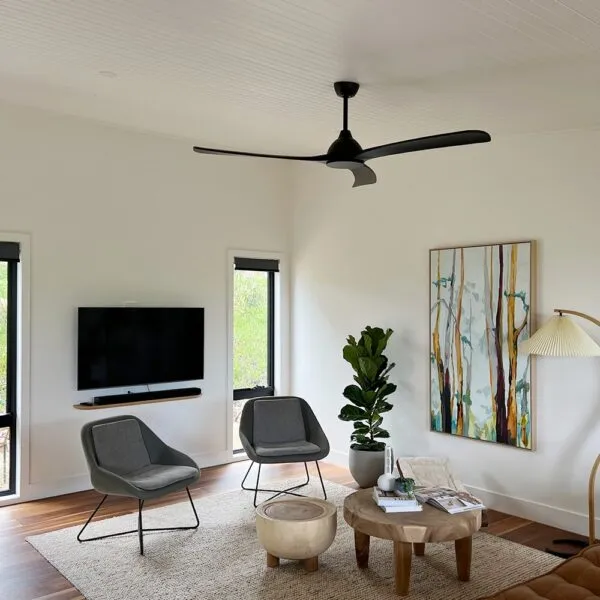
Height matters as well. The blades need to be at least 2.1 metres off the floor, so in rooms with a standard 2.4 metre ceiling a close-to-ceiling fan is the usual choice. Raked and high ceilings take a downrod to bring the fan down to a useful height, and some need an angled mount.
Can a ceiling fan help in a Canberra winter?
Yes, and it is a good reason to choose a fan with a winter setting. YourHome explains that in winter mode a ceiling fan draws cool air upward, pushing the warm air that collects at the ceiling sideways and down the walls, with little wind chill. Run it slowly in reverse alongside your heater or split system. It helps most in rooms with high or raked ceilings, which are common in Canberra renovations and newer homes.
Can a ceiling fan go where an existing light is?
Usually, and it is the simplest install. The light point already has power from the lighting circuit, so we can often fit the fan in the same position. A few things decide how simple it is:
- What the ceiling can hold. A ceiling fan has to be fixed to a joist or a proper brace between the joists, never just the plasterboard. A spinning fan puts a moving load on its mount, so if there is nothing solid in the right spot, we fit a brace.
- Ceiling access. Single-storey homes with a roof space make it easy to run cables and fit bracing. Ground-floor ceilings in two-storey homes and flat or raked ceilings with no roof space take more work.
- Fan and light switching. With a remote, the fan and light can share the existing switch. If you want the light on its own wall switch, or switched from two doorways (two-way switching), we may need to run another cable.
- A new position. If you want the fan away from the existing light, or in a room with no ceiling light, we run a new cable from the lighting circuit.
Do you need an electrician to install a ceiling fan?
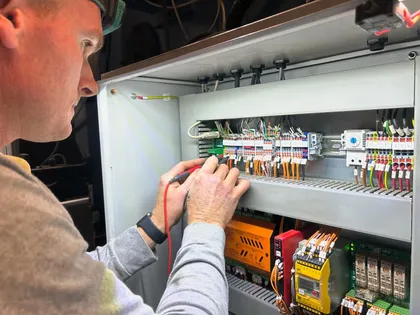
Yes. In the ACT, installing low voltage wiring needs an unrestricted electrical licence, as Access Canberra’s electrical guidance points out. Beyond the licence, a ceiling fan is a heavy, spinning appliance above where you sleep. A licensed electrician checks the lighting circuit has safety switch protection, fixes the fan to the framing, sets the blade height and balances it so it runs smoothly.
Summer is the busy time for this work. In our own quote requests, fans and exhaust work make up 14% of summer requests against 6% in winter, as covered in our Canberra electrical enquiries study. Booking before the first heatwave is the easiest way to avoid the wait.
Should you choose a DC or an AC ceiling fan?
Choose DC for bedrooms, nurseries, studies and living areas where the fan runs for hours: lower power use, quieter running, more speeds and a remote with timer and winter mode.
Choose AC for garages, sheds, alfrescos and rooms you use occasionally, where the lower purchase price matters more than the power saving and a wall controller suits you.
If you are fitting fans in several rooms, it is often worth doing them in one visit, and pairing fans with a split system lets you set the air conditioner a few degrees higher in summer. Our split system installation guide covers the electrical side of that. When you are ready, send us the rooms, ceiling heights and photos of the existing lights through our fans and exhaust page and we will quote the job.
Frequently asked questions
Are DC ceiling fans worth the extra cost?
For bedrooms and rooms where the fan runs for hours every day, usually yes. DC fans use about half the power of a traditional AC fan (YourHome puts them at about 30 watts), run more quietly and have more speeds. For a garage or a room you rarely use, an AC fan is a reasonable way to save on the purchase price.
Can you put a DC ceiling fan on a normal wall switch?
Yes. A DC fan still runs on normal 240 volt power, so it is wired to a wall switch or isolator to turn it on and off. Speed and direction are usually set with the remote or a dedicated wall controller made for that fan, not a standard AC fan speed controller.
Can a ceiling fan go where my light is now?
Usually. The existing light point already has power, so the fan can often go in the same spot if the ceiling framing can take it. We fix a proper brace between the joists if there is nothing solid to mount to, and the light can be kept by choosing a fan with a light kit.
How high does a ceiling fan need to be?
The blades need to be at least 2.1 metres above the floor. In a room with a standard 2.4 metre ceiling, that rules out long downrods, so a close-to-ceiling mount is the usual choice.
Do ceiling fans help in winter?
Yes, if they have a winter (reverse) setting. Running slowly in reverse, the fan pushes warm air that has collected at the ceiling back down the walls without creating a breeze. It helps most in rooms with high or raked ceilings and a heater or split system.
Can I install a ceiling fan myself in Canberra?
No. In the ACT, installing fixed wiring needs an unrestricted electrical licence. A licensed electrician also checks the circuit, the switching and how the fan is fixed to the ceiling, which matters for something that spins above your bed.
Conclusion
For most Canberra bedrooms and living areas, a DC ceiling fan is the better choice: it uses about half the power, runs quieter and gives you more control over speed. AC fans still make sense for garages, sheds and rooms you rarely use. Whichever you choose, size it to the room and have it fixed to the ceiling framing and wired by a licensed electrician. Fused Electrical Co is a family owned and run Canberra business, licensed and insured, with fixed-price quotes and a reply within 24 hours. Call 0434 913 935 or request your free quote online before the first hot nights arrive.
Published Date:
Link copied!
Talk to a licensed Canberra electrician.
Family owned, rated 5.0 from 163 Google reviews. Serving Canberra, the ACT and Queanbeyan.
Article Sources / Publishing Guidelines
Sources
- yourhome.gov.au · heating and cooling
- energy.gov.au · heating and cooling
- accesscanberra.act.gov.au · Split Air conditioning units
At Fused Electrical Co, we are committed to publishing content that is accurate, trustworthy, and useful for our readers. To maintain these standards, we follow a rigorous process:
- All content is crafted to be clear, helpful, and regularly updated.
- We adhere to strict practices, including:
Editorial Guidelines
Fact-Check Content
Vet Expert Sources
Content Creation Process - If you have any questions, concerns, or if you’ve found an error in our content, please contact us.